What is a Solar Cycle?
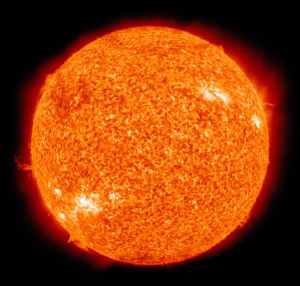
Per NASA (National Aeronautics and Space Administration), the solar cycle is the period of changes that the Sun’s magnetic field goes through. It is measured in variations in the number of observed sunspots on the solar surface. Over approximately 11 years, solar activity fluctuates in large swings like a pendulum, from minimum to maximum and back again. One cycle ends and the next begins at solar minimum.
Scientists believe that this cycle system is tied to the poles of the sun. Basically, the sun has a north pole and south pole and a magnetic field generated by them, just like the Earth. And also, just like Earth, the poles switch places. No really. Earth’s poles just don’t change very often, like every 200,000 – 300,000 years. When the poles switch places, the cycle starts over again.
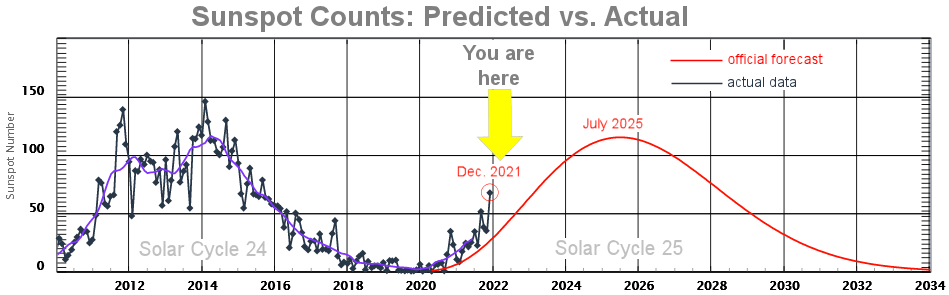
We are currently in Solar Cycle 25. It started in December 2019 and will last till roughly December 2030 with a predicted maximum in July 2025. An international group of experts co-sponsored by NASA and NOAA (National Oceanic and Atmospheric Association) come together to look at previous cycles and averages and make a prediction of what the upcoming solar cycle will bring. Not quite like weather forecasting, but similar.
Solar Cycle 24 was a below-average activity cycle. Per the Farmer’s Almanac, it was the lowest activity cycle in 100 years. The prediction from the expert panel is that Cycle 25 will continue in the same vein. However, we are 2 years in and it’s not shaping up as predicted. It’s been more active. Check out the chart from NOAA below.
What does all this mean for us?
So why should your average, everyday person, i.e. not a scientist studying this, care about the solar cycle? Well, we are affected by more than the sunlight we get which makes our planet livable. The sun’s electromagnetic activity affects the Earth too.
Giant eruptions on the Sun, such as solar flares and coronal mass ejections (CME), increase and decrease during different parts of the solar cycle. These eruptions send powerful bursts of energy and material into space. That energy can interfere with our satellites, electrical systems, radio signals, and anything involving energy on our planet.
And what have we here on Everyday Sisters said about energy? Everything is energy. That is why you should care about this. This solar activity affects the whole grid of energy that we live in.

That means when the next CME happens and flings a large quantity of energy at Earth, not just your cell phone and satellite TV gets affected. So does your personal energy field and the grid you send your energy out on with every thought and heartbeat.
Now you are wondering what do you do with this knowledge? I mean it’s the sun, so it’s not like you can stop it from throwing things at us. And there isn’t something for your energy like sunscreen, that you can toss on before you walk out the door to minimize exposure.
The main thing you can do is your energy work. Keep things clean and smooth for as much of the time as possible, so there aren’t any little waves to turn into big ones. Additionally, watch the patterns and try to give yourself and others the opportunity to engage when the energy is calm and to focus on self-care when things are more turbulent.
Lastly, is grace. Always give yourself and others as much grace as possible. You never know if they have small waves, big waves, or a smooth, glassy surface. And if the solar energy is amplifying their personal energy or roiling it, they need all the grace they can get.
 Everyday Sisters
2 thoughts on “The Solor Cycle”